Butter bread
Overview
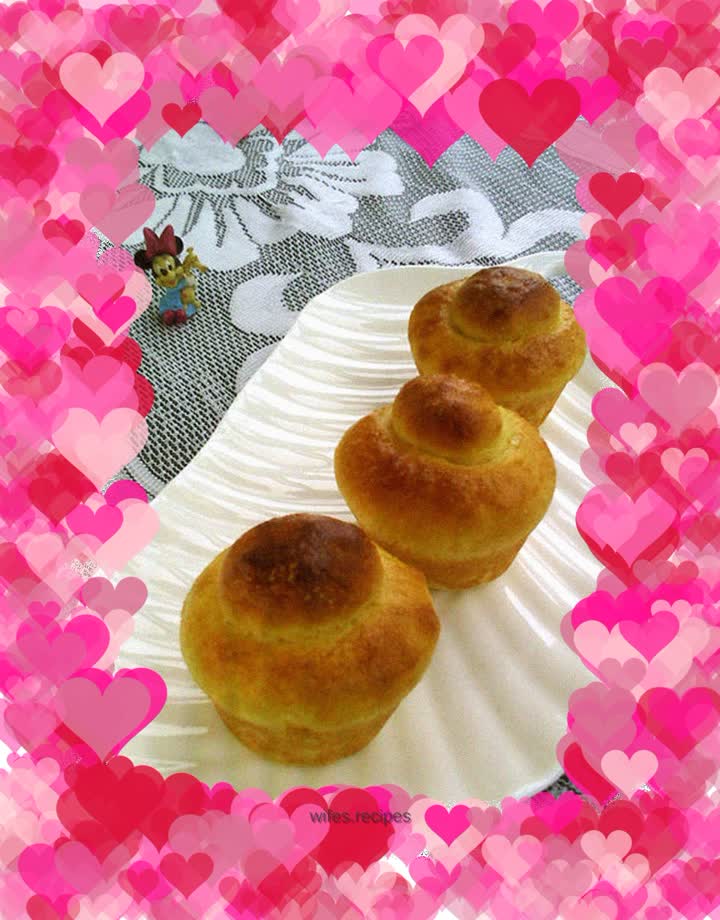
This is actually Briosio. There are three versions in "The Baker's Apprentice": the rich version, the middle class version, and the poor version. I vaguely remember that the main difference between them seems to be the amount of oil and sugar used. I don’t know which version of the bread detailed book should be considered? Brioche has special molds, which are a bit like petal-shaped egg tart molds, in various sizes. I don’t know what model the Japanese master used. However, I didn't plan to tinker with Briosio's mold. I guessed the size of the mold and turned it out to replace it with the twelve zodiac cake molds - the size may be similar, but there are no petals, and the opening angle of the upper mouth is smaller. The monk-headed brioche bun made from a 10-petal Brioche mold is placed on the little head and is wearing a lace tutu. It looks interesting and cute. And the look made with a cake mold will probably look more clumsy, right? The book's confusion of names for butter and cheese is fully demonstrated here - there is no butter in the recipe, only cheese (chilled in the refrigerator), but in the steps, there is no cheese, only butter. So, cheese = butter. In the Danish bread at the back, butter is completely replaced by cheese - there is no word butter in the whole article, only cheese. Then, from the way of wrapping cheese into dough, it is not difficult to think that cheese is butter. However, I never like to make Danish bread crispy, and I don't bother to make it if it's not necessary, so I don't need to care about what the cheese is. Going back to butter bread, which is quite heavy bread, the amount of butter is half that of flour. As many eggs as butter go with the butter to give the dough an extra brown look. The dough is quite soft and shiny, and it's a bit overwhelming to grab a handful of oil. The Japanese master's method of making the monk's head is quite interesting - using his hands as a knife, he cuts and rolls the dough into a small head connected to the body, which looks like a lying down snowman. Then he straightens it, puts it into the mold, and puts the head into the body. This was really not easy to do. Each little monk's head was swaying all over the place, but in the end he was finally on the right track. The final result was pretty good. The dough expanded and just reached the mouth of the mold, indicating that the capacity of this cake mold should be similar to that of the Japanese master's mold. After fermentation and baking, the little monk's head was almost tilted to one side. It seemed that this head was really not easy to place. . . . . .
Tags
Ingredients
Steps
-
Materials

-
Pour all ingredients except butter into bread pan

-
Mix the dough for 13 minutes

-
Add butter and use the dough cycle again for 30 minutes

-
Can pull out transparent film

-
Place in a large bowl, 28 degrees Celsius, and ferment for 90 minutes

-
The dough has grown

-
Put it into a flat plate, press it flat, seal it with plastic wrap, put it in the refrigerator, and refrigerate it for 15-20 hours

-
Take out

-
Fell on the counter

-
Fold in half

-
Organize into rectangles

-
Divide it into two parts along the length

-
Divide it into 7 equal parts and round

-
Press flat and relax for 20 minutes

-
Round again,

-
Using your hand as a knife, cut out 1/4 of the dough and roll out a small dough

-
Put the dough into the oiled mold, hold the small dough in your hand, and press the large dough to make a nest

-
Embed the small dough into the large dough, ferment at 32 degrees for 60 minutes

-
When the dough grows, brush the surface with egg wash

-
Put in the oven, middle layer, heat up and down at 220 degrees, bake for about 12 minutes

-
Golden on the surface, out of the oven

-
Immediately remove from the mold
