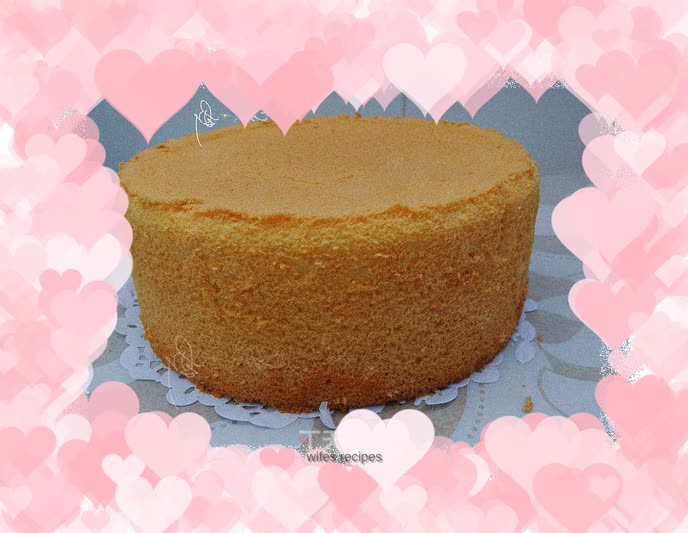
Six-inch chiffon cake - a cake that does not crack
Overview
I don’t know when the chiffon baked since last month was not satisfactory and collapsed. I think back to the time when I made it several times before and it collapsed. I remember that when I first came into contact with the chiffon, it didn’t collapse. It was just that it shrank when I was in a hurry to unmold it. When I saw the chiffon baked now, I realized how imperfect the original chiffon was. Because they were not perfect, I spent the past two months baking chiffon cakes without doing anything else. I baked them when I had time. Sometimes I baked three cakes a day. I would bake them again when they were flat, and bake them again when they were flat. I would finish the flat cakes silently, and there were really a few days when I just ate eggs. The cake was full, and it collapsed so many times that I really had to reflect on myself. I thought the egg whites I whipped were enough, but in fact it was not enough, so I corrected myself. I baked it with Junzhi’s recipe and was not satisfied with it, then changed the recipe again, and finally baked eggs that did not collapse. It was cakey, but it cracked. Although the cracking was not serious, it felt like there was a thorn in my heart, or it could be said that it was an episode of obsessive-compulsive disorder. I just wanted a perfect chiffon cake. I tried it at high and low temperatures and it still cracked. They said the cracking was caused by the high fire temperature. So I simply adjusted the cooking temperature to a low level, and now I have this chiffon cake that does not crack or collapse. I feel so happy at last. I don’t know why I have such perseverance this time. I hope I will be so persistent in the future!
Tags
Ingredients
Steps
-
Weigh the required raw materials. The eggs used here are large, with shells between 65-70 grams. For oil, choose sunflower oil or rapeseed oil. Do not use peanut oil or butter

-
First prepare two clean basins. The container for egg whites must be oil-free and water-free. Separate the egg whites and egg yolks. Add a few drops of lemon juice to the egg whites. The addition of lemon juice to the egg whites will help the stability of the egg whites after being whipped. You can try the whipped egg whites that are not easy to defoam. If you don’t have lemon juice, you can use white vinegar or cream of tartar. The same principle applies

-
Turn the whisk on low speed and beat the egg whites until dense bubbles appear. Add one-third of the fine sugar and continue beating. The whisk can be slowly adjusted to medium speed

-
When the egg whites are beaten until the bubbles are thick, add another third of the fine sugar. The egg beater can be slowly adjusted to high speed

-
When the egg whites are beaten until texture appears, add the remaining one-third of the fine sugar and continue beating at high speed until stiff peaks form. When the beating is almost done, you can turn back to low speed and beat for a while to make the egg white bubbles more even and delicate

-
When the meringue that has been beaten to a hard level is lifted, you can see straight and unbent corners when you lift the egg beater, and the bubbles of the egg white are very delicate like whipped cream. If it is not beaten to this level, you must continue to use the egg beater to beat the egg white. The beating of the egg white is related to the success or failure of the chiffon cake, so you must pay attention to it

-
After the egg whites are beaten, set them aside or put them in the refrigerator to refrigerate. At this time, you can preheat the oven to 120 degrees and lower the heat to 160-170 degrees. Now make the egg yolk paste. Add 10 grams of fine sugar to the egg yolks. Turn the egg beater on low speed and beat evenly

-
While pouring the oil into the egg yolk, continue to beat the egg yolk at low speed until the egg yolk is thick and there is no separation between the egg yolk and the oil.

-
Pour the milk into the egg yolks and beat well

-
Sift low-gluten flour into egg yolks

-
Use a spatula to stir evenly into a lump-free egg yolk paste

-
Add one-third of the beaten egg whites into the egg yolk batter, and mix well using cutting and stirring techniques

-
Pour the mixed egg yolk paste back into the remaining beaten egg whites, and mix well by cutting or turning. Don't be too cautious, just turn it boldly. Don't mix for too long, which will cause the egg whites to defoam

-
The mixed cake batter should be thick and light in texture, as shown in the picture

-
Pour the cake batter into a six-inch cake mold, lift the mold to a level with the table and shake it several times to pop the big air bubbles inside

-
Put it into the oven with the upper heat at 120 degrees and the lower heat at 160-170 degrees. After baking for 20 minutes, the cake reaches the highest point. At this time, adjust the upper and lower heat to 150 degrees and continue baking for 20 minutes

-
The cake has been baked for 20 minutes. Now adjust the temperature to 150 degrees and continue baking for 20 minutes.

-
After the cake comes out of the oven, gently knock it down a few times, turn it upside down immediately, and remove from the mold after cooling

-
After removing the mold with clean hands, the cake is fully molded. This is the most satisfying cake I have baked so far

-
It doesn’t collapse or crack, it’s perfect

-
The organization is not perfect, but it is still good
