Chive Cookies
Overview
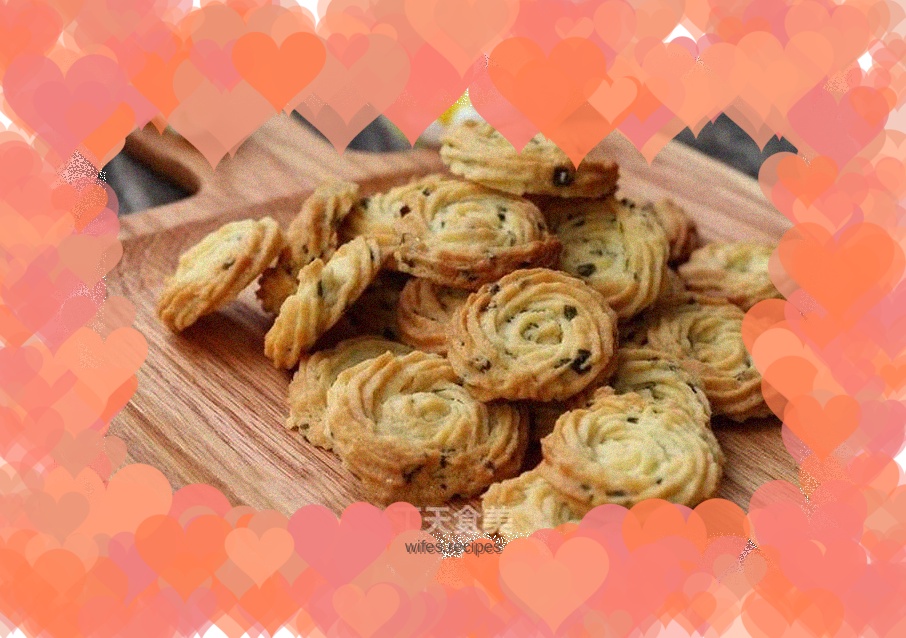
Cookies are a very popular baked good. Whether you are an adult or a child, it is difficult to resist its temptation. The cookies in the store are not cheap even for a jar, so I really can’t bear to buy them. Every time the little one wants it, I say to her, go back, mom will make you a little one, but she is quite obedient, so she just follows me. I have made cookies many times. Different cookies have their own characteristics, but their methods are similar. I have summarized a few points, I hope it will be helpful to enthusiasts. The first is the moisture content of the dough. The higher the moisture content, the better the ductility. Take a look at your cookie dough. Is it very dry or wet? If the dough is too wet, the patterns will disappear. If the dough is too dry, it will be difficult to squeeze out the patterns. Both are undesirable. The second is the baking temperature. The higher the temperature, the worse the ductility. Cookies are generally best baked at 190-200 degrees, and the temperature should not be too low. Because I used the baking pan that comes with the oven, and the black one has high thermal conductivity. If the temperature near the bottom of the baking pan is too high, it will easily cause the cookies to burn, so I set the lower heat temperature to 175°. Finally, the thickness of the sugar. In the cookie recipe, fine granulated sugar and powdered sugar are present at the same time to balance the extensibility of the cookie. Cookies that only use powdered sugar will have too low ductility and the cookies will not be crispy enough; but cookies that do not use icing sugar will have too high ductility and the pattern will not be easy to shape, so use it yourself.
Tags
Ingredients
Steps
-
After softening 120 grams of room temperature butter, add 100 grams of powdered sugar and 6 grams of salt

-
Use a spatula to stir evenly to prevent the sugar from splattering when whipping with a whisk

-
Beat butter until fluffy and white

-
This is the state

-
Add 80 grams of corn oil and stir evenly

-
Add 100 grams of water

-
Add chopped scallions (only the chopped scallions, not the white ones) and add to the butter

-
Sift in 400g of low flour and stir together evenly. Do not over-stir and use a spatula to stir until there are no grains to prevent the flour from forming gluten

-
Use a spatula to stir until there are no lumps

-
Place tin foil on a baking sheet, use a small chrysanthemum nozzle to squeeze out patterns. Preheat the oven to 180°, raise the heat to 200°, and bake the middle layer at 175° for 15 minutes
