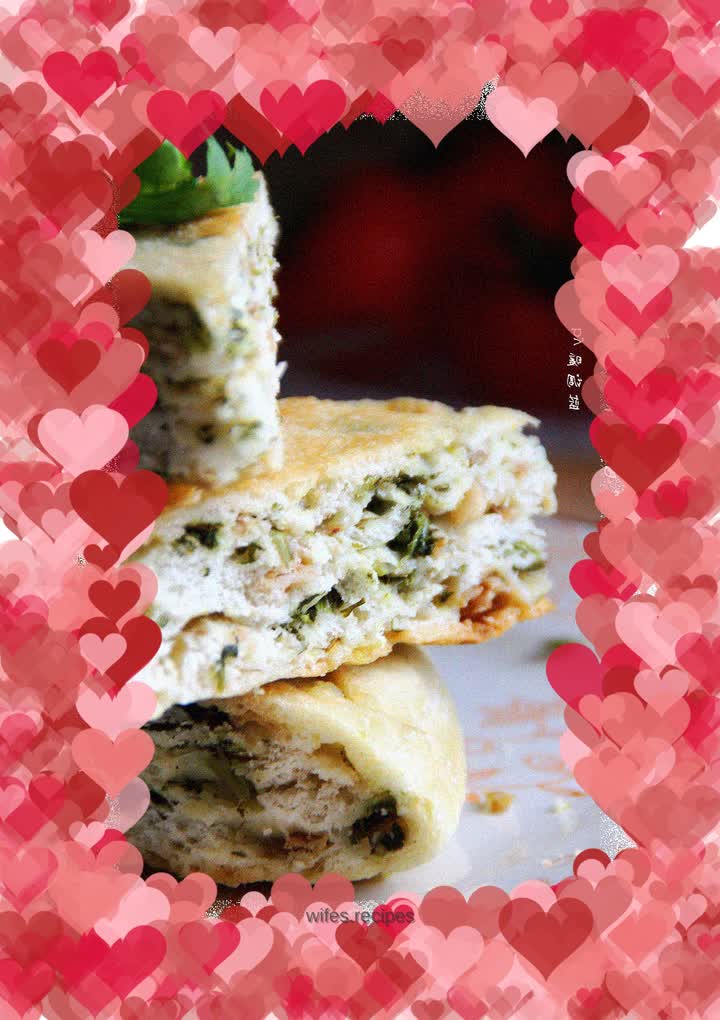
【Thousand-layer dough cake with scallion and oil residue】
Overview
Lard residue, as the name suggests, is the residue left after the fat is extracted from pork. Although from the outside, Lard Residue is a shabby settlement that makes people look down upon. But the crispy texture and rich and oily satisfaction make it as delicious as the family elites such as ribs, pork belly, and tenderloin. A few days ago, I made some lard, and naturally there was lard residue as a by-product. I didn't think about how to eat it, but I happened to see the oily scallion layer cake made by a blogger. I felt that my greed was suddenly attracted, so I decided to make this cake. The blogger’s pie crust uses dead dough bread. I prefer fermented dough pancakes to dead dough pancakes. I personally think that yeast bread has a better texture and taste, and is easier to digest, so I make yeast bread. In the layers of pie crust, there are finely chopped lard residue and chopped green onion. The two blend with each other. You have me in you, and you have me in you. One is plump and oily, and the other is fragrant and relieves greasiness. They are definitely a perfect soulmate. Coupled with the crispy skin and soft inside, this is so delicious that it will make you bite your tongue! (The following quantities can make a puff pastry with a diameter of about 24cm)
Tags
Ingredients
Steps
-
Weigh the flour, dissolve the yeast powder in the water, and let it sit for a few minutes;

-
Mix the yeast water and flour, knead it into a smooth "3-light dough", cover it with a lid or plastic wrap, and place it in a warm and humid place for fermentation;

-
Wait for fermentation time and start making stuffing. Prepare oil residue, chives, coriander, etc.;

-
Chop the oil residue into small pieces;

-
Wash the chives, etc. and chop them into small pieces;

-
Put the oil residue and chives in a large basin, add salt and freshly ground black pepper, mix well, and set aside;

-
Let the dough ferment until it doubles in size;

-
Take out the fermented dough, deflate it and roll it out into a square piece. In the middle 1/3 of the dough, make 4 horizontal cuts (the positions of the 4 black lines), but be careful not to cut them. This picture was accidentally deleted, so I had to draw another one to replace it;

-
Spread the filling on the dough, spreading it as evenly as possible. A small piece in the lower right corner, no filling required;

-
Fold a small piece of dough from the lower right corner to the left and pinch the edge;

-
Fold a small piece of dough from the lower left corner to the right and pinch the edge tightly;

-
Fold the remaining row of dough upwards and pinch the edges;

-
Repeat steps 10~12, and finally fold the dough into a square shape;

-
Sprinkle a little dry flour on the cutting board, flatten the dough gently with the palm of your hand, and then slowly and carefully roll it out into a square or round piece. There is no need to be too thin here;

-
Heat a flat pan without holding it, and pour in a little cooking oil (just a little bit is enough, half of the oil in my picture ended up being poured out);

-
Put the dough pieces into the pot, cover the lid, turn to low heat and fry slowly;

-
Fry one side until lightly browned and hard, then flip over, then cover and continue to heat over low heat. Repeat flipping several times until the pancake is cooked through, golden brown on both sides and crispy on the surface. My cake is about 24cm in diameter, and I heated it over low heat for about 25 minutes;

-
Take out the cake, place it on kitchen paper, and slightly absorb the fat on the surface;

-
Cut into pieces, plate and serve hot.
